What 6 Hours on a Bike Taught Me About Doing Hard Things
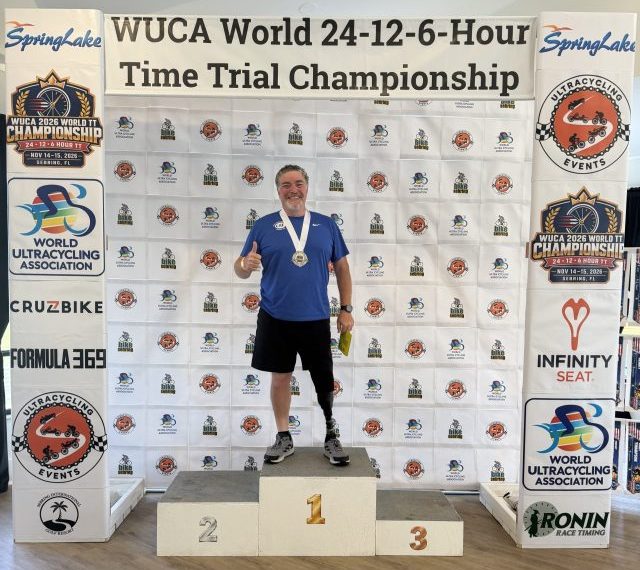
This past weekend, I completed my first six-hour cycling time trial at the WUCA World TT Championship, riding my Cruzbike V20c on a flat 3.66-mile loop. As a 53-year-old below-knee amputee, I went into the event with plenty of questions about how my body, my prosthetic, my fueling strategy, and even if my mindset would hold up over six continuous hours.
My goal was 100 miles. I finished with 91.5 and took first place in my category, Male 50–59, Para Cycling, Recumbent.
Of course, part of me immediately focused on the 8.5 miles I did not get. That is how goals work sometimes. We can accomplish something significant and still look first at what we missed. But after reviewing the day, I realized the result gave me something even more valuable than the number I had hoped for, a clear baseline and a much better understanding of what it takes to perform well over six hours.
I had prepared carefully, but there are some things you can only learn by doing them. I knew pacing would matter, but I did not fully appreciate how much patience the early hours would require. When you feel good, the bike feels fast, and with other riders are around you, it is easy to let excitement dictate the pace. In an endurance event, though, the first few hours are really about protecting the second half.
I also learned how much execution matters. My moving time was about five hours and 35 minutes, which means I spent roughly 25 minutes in the pit area. Some of that was necessary, but some of it probably was not. Based on my moving speed, I was much closer to 100 miles than the final total suggested. That was encouraging because it showed me that the next step is not simply “get fitter.” It is also about becoming more efficient.
Fueling was another important lesson. I combined liquid carbohydrates with solid food and by the final hour I felt bloated and overly full. I had been focused on making sure I did not underfuel, but in the process I probably made things more complicated than they needed to be. Next time, I plan to simplify the strategy and rely more heavily on what I know my body tolerates well.
The final hour was where the event became less about training and more about mindset. Fatigue has a way of making every small discomfort louder, and that is where doing something difficult becomes valuable in a way that goes beyond sport. You learn that discomfort is not the same thing as danger, that feeling tired does not mean you are finished, and that you can continue even when your body and mind are both asking for an easier option.
That is one of the reasons I believe doing hard things is so beneficial. We spend a lot of time trying to avoid discomfort, uncertainty, and situations where we might fail, but confidence is rarely built by waiting until everything feels easy. More often, it comes from stepping into something difficult, learning as you go, and discovering that your limits were not exactly where you thought they were.
For me, that lesson has even more meaning as an adaptive athlete. Living with a disability means there are always external assumptions about what you can or cannot do. Challenges like this provide an opportunity to answer that question for yourself. It’s ability that matters, not disability.
I did not reach 100 miles, but I finished six hours, won my category, learned where I lost time, learned what I need to change with fueling, and proved that the distance is within reach. That is a pretty good return on a first attempt.
Now I am looking ahead to another six-hour event, with 100 miles as the next goal. After that, I want to pursue a WUCA record in my category.
The biggest takeaway from this first event is simple: you do not have to be completely ready before you begin. Sometimes you just need enough preparation to start, enough humility to learn, and enough determination to keep going when it gets uncomfortable.
Hard things are worth doing, not because suffering is the goal, but because they have a way of showing you what you are capable of.


Related Posts
Sailing Into Year Ten-The Follow-Up
Ten Years Later: Cruising as a Below-the-Knee Amputee – The Follow-Up A…
17 November, 2026
Resolutions – Why Wait?
2020 and 2021 felt like they were one long challenging year and as the end…
17 November, 2026
Leave A Comment